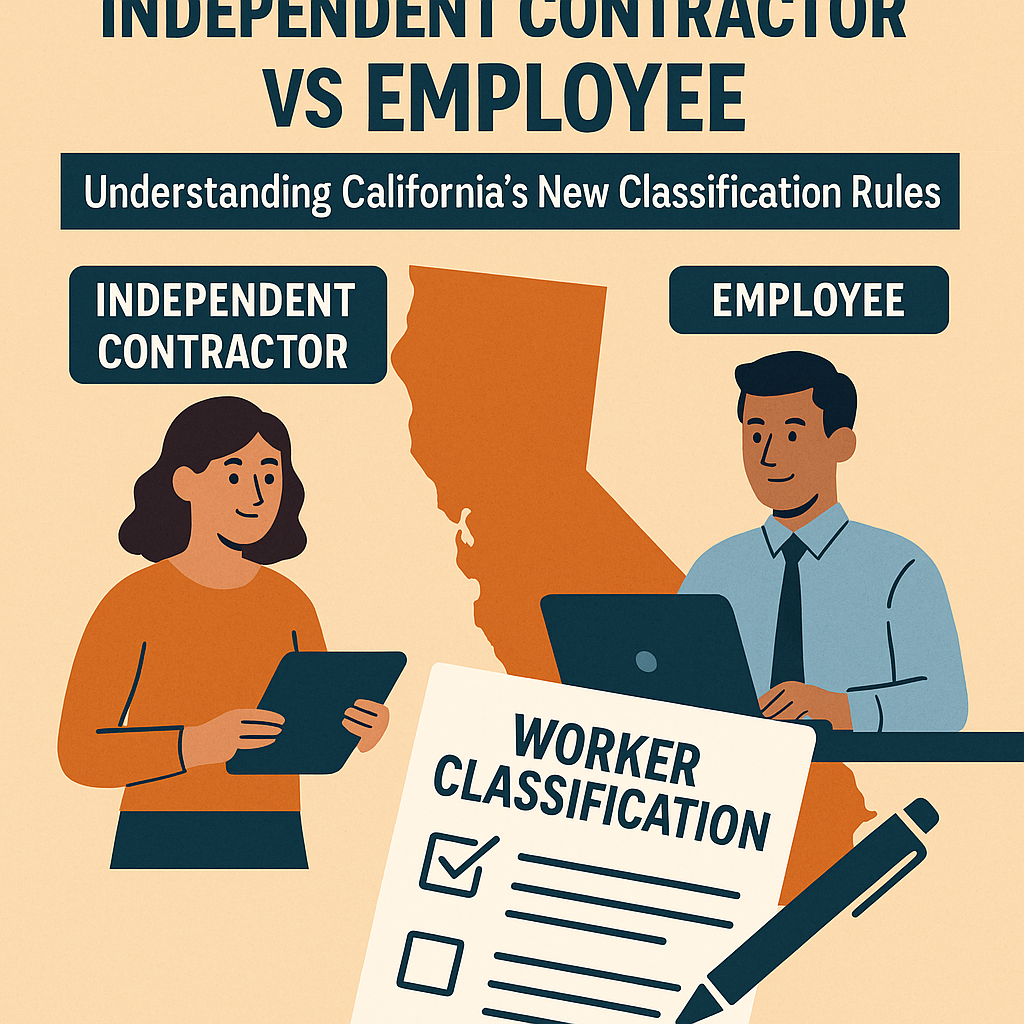
Independent Contractor vs Employee: Understanding California’s New Classification Rules
The distinction between an independent contractor and an employee has always been crucial for businesses and workers alike. In California, recent changes to laws and regulations have further complicated this divide. Understanding California’s latest classification rules is essential for employers to remain compliant and for workers to know their rights and benefits.
Why Classification Matters
Correctly classifying a worker as either an independent contractor or an employee impacts:
- Tax obligations
- Eligibility for benefits
- Labor law protections
- Unemployment and workers’ compensation coverage
Misclassification can lead to serious legal consequences, including fines, penalties, and back payments of wages and benefits.
The Basics: Independent Contractor vs. Employee
Employee Characteristics
An employee typically:
- Works under the direct supervision and control of the employer
- Has set working hours or schedule
- Uses company-provided tools and equipment
- Is entitled to minimum wage, overtime, and workers’ compensation
- Can be eligible for benefits such as health insurance and paid leave
Independent Contractor Characteristics
An independent contractor usually:
- Controls how and when to perform their work
- Uses their own tools and materials
- Can work for multiple clients simultaneously
- Is paid per project or contract, not by the hour or salary
- Is responsible for their own taxes and benefits
California’s Latest Legal Framework: The ABC Test
At the core of California’s latest classification rules is the ABC Test, established by the California Supreme Court in the landmark Dynamex case and codified in legislation such as Assembly Bill 5 (AB5).
According to the ABC Test, a worker is presumed to be an employee unless the hiring entity demonstrates all three of the following:
- (A) The worker is free from the control and direction of the hirer in connection with the performance of the work, both under the contract and in fact.
- (B) The worker performs work that is outside the usual course of the hiring entity’s business.
- © The worker is customarily engaged in an independently established trade, occupation, or business of the same nature as the work performed.
If any one of these criteria is not met, the worker must be classified as an employee.
What this Means for Businesses
The ABC Test shifts the burden of proof to employers who want to classify workers as independent contractors. This change has significant implications:
Increased Compliance Requirements
Employers must carefully review contracts, job duties, and business models to ensure classification aligns with legal standards. Many companies have had to reclassify workers as employees, impacting payroll, tax filings, and benefit administration.
Impact on Gig Economy Companies
Service providers like rideshare and delivery companies initially relied heavily on contractor classifications. The ABC Test has forced many to rethink their staffing models, with some adopting hybrid or full employment models in California.
Exceptions and Exemptions
AB5 initially applied broadly but includes numerous exemptions for professions such as:
- Licensed professionals (lawyers, doctors)
- Certain freelancers (writers, photographers)
- Construction subcontractors
- Real estate agents
Employers should familiarize themselves with these exemptions as they can be complex and sector-specific.
Protecting Worker Rights
For workers, the new rules mean better protections, including:
- Guaranteed minimum wage and overtime pay
- Access to workers’ compensation and unemployment insurance
- Eligibility for paid sick leave and family leave
- Contribution to Social Security and Medicare taxes through employer withholding
This shift aims to reduce the exploitation of workers classified wrongly as contractors and provide fairer compensation and workplace protections.
Tips for Navigating California’s Classification Rules
For Employers:
- Conduct regular audits of worker classifications and contracts.
- Seek legal advice to understand exemptions and compliance measures.
- Train HR teams and managers on the latest standards and documentation.
- Consider restructuring job roles to clearly differentiate contractor work from employee duties.
For Workers:
- Know your rights under California labor laws.
- Request clarity on your classification and contract terms.
- Report suspected misclassification to state labor agencies if necessary.
Conclusion
California’s latest classification rules, centered on the ABC Test, have transformed how businesses and workers approach the independent contractor vs. employee distinction. Staying informed and compliant is now more important than ever in this evolving legal landscape. Employers and workers alike must understand the definitions, exceptions, and consequences to navigate these rules effectively and safeguard their interests.
By grasping the nuances of California’s classification laws, businesses can avoid penalties, and workers can secure the protections and benefits they deserve.